


HOME > CONDITIONS > SCARRING
SCARRING


HOW IS SCARRING TREATED?
A scar is part of your body’s natural healing process. It forms when an injury reaches the deeper layers of the skin, and the body produces new tissue to repair it. They can develop after surgery, burns, acne flare-ups, accidental injuries, or other forms of skin trauma, including self-injury. Whatever the cause, our focus is on understanding how your skin has healed and what support you might need now.
How your scar healed is one of the most important factors in how it’s treated. Some scars become flat and gradually fade, while others may stay red or darker, become raised and firm, or sit below the surrounding skin. Once a scar is fully healed and stable, clinical treatments may help reduce how noticeable it is by addressing changes in colour, texture, depth, or tethering.
If a scar hasn’t fully healed or feels painful and inflamed, medical assessment may be needed first. During your consultation, we’ll look closely at the skin and explain whether clinical scar reduction treatments may be suitable.
Related skin conditions
Products & services
- Consultation
- Referral support
- Laser treatment
- Microneedling
- Subcision

TYPES OF SCARS
Scars are often named after what caused the original wound (a surgical scar, a burn scar, an acne scar). These same injuries can produce very different scars in different people. Factors such as wound depth, location, skin tone, genetics, inflammation, tension across the wound, and any healing complications can all influence the final result.
In practice, clinicians generally assess them by how the tissue has actually healed (flat, raised, indented) and how the scar presents now, rather than the cause alone. Because more than one characteristic may also be present in a single scar, treatment needs to be carefully considered. A surgical scar, for example, might be flat and linear along one section but raised, red, or tethered along another.
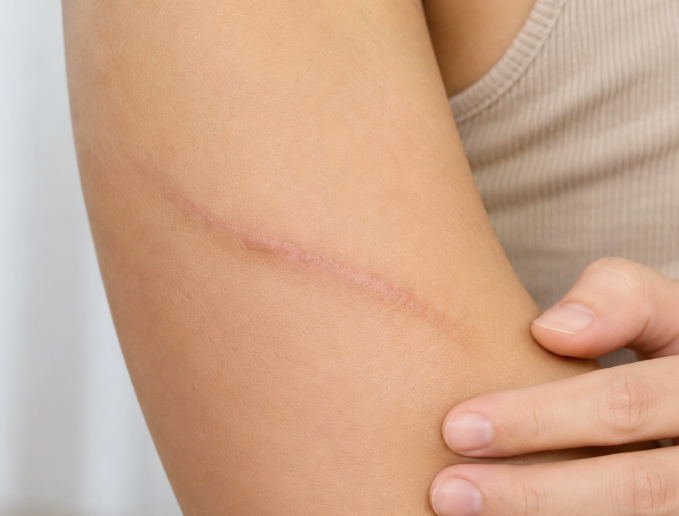
FLAT AND LINEAR SCARS
Flat and linear scars generally follow the original line or shape of a healed wound. They’re commonly associated with surgical incisions, cuts and lacerations, accidental injuries, and medical procedures.
Early on, they may look red, pink, purple, or darker than the surrounding skin. As they mature, many become flatter and lighter, though some remain visibly discoloured or uneven in texture.

HYPERTROPHIC SCARS
Hypertrophic scars are raised and firm, but generally stay within the boundaries of the original scar wound. They may develop after surgery, burns, injury, or prolonged inflammation, can appear red or darker than nearby skin, and may feel itchy, tight, or uncomfortable.
Hypertrophic scars can gradually become less noticeable over time, but assessment is important before introducing any clinical treatment.

ATROPHIC SCARS
Atrophic scars sit below the level of the surrounding skin because not enough supporting tissue formed as the wound healed. They may appear as shallow depressions, narrow or deeper indentations, tethered areas that pull inward, or broader patches of uneven texture.
While most often associated with acne, atrophic scars can also follow chickenpox, injury, surgery, or other tissue damage. Where acne is the cause, you can read more on our acne scarring page.

CONTRACTURE SCARS
Contracture scars form when scar tissue tightens as it heals. They’re often associated with burns or significant injuries, and can restrict movement where they cross a joint or cover a larger area. Any scar that limits movement is considered a contracture scar.
These scars need medical assessment, and treatment often involves multidisciplinary care rather than cosmetic skin treatment alone.

KELOID SCARS
Keloid scars are typically raised scars that extend beyond the boundaries of the original wound. They can keep growing after the wound has healed, and sometimes appear months later. They may follow surgery, piercings, burns, cuts, injections, tattoos, or other skin injuries.
Keloids are different from hypertrophic scars, and they generally require medical assessment and combination management rather than standard resurfacing treatments alone. If you have an active or growing keloid, Victorian Dermal Group will refer you for medical review first. Laser, microneedling, and subcision may not be appropriate for active keloid scars, and treating one as such can make it worse.
CLINICAL SCAR REDUCTION TREATMENTS
Every scarring treatment begins with a consultation. Depending on the scar, treatment may focus on softening raised or firm tissue, improving indented or uneven texture, reducing persistent redness or discolouration, supporting flexibility where tissue feels tight, or easing symptoms like itching or discomfort.
Where a scar is growing, painful, inflamed, restricting movement, not yet fully healed, or possibly hypertrophic or keloid, Victorian Dermal Group may recommend medical review first, and can refer you to a trusted dermatologist, GP, or plastic surgeon.
For health and safety reasons, we don’t perform clinical scar treatments on clients under 15, as the scar and surrounding skin may still be healing.
SCAR TREATMENTS
Scar treatment is often staged, with changes developing gradually as the skin remodels. These before-and-after images show real treatment journeys for different types of scars. Individual responses will vary, and your clinician will discuss what may be realistic for you before treatment begins.


FRAXEL TREATMENT
YOUR FREQUENTLY ASKED QUESTIONS
Here, our dermal clinicians have answered some of your most frequently asked questions about scar treatment.
There’s no single best treatment, because the most suitable approach depends on the scar. Raised or firm scars, indented or tethered scars, and scars that are mainly discoloured each respond to different methods, from Fraxel® laser to microneedling, Vivace® RF microneedling, or subcision.
Results always vary from person to person, and depend on a number of factors, including:
- The type of scar and how it originally healed
- Its age, depth, and firmness
- Its location across the face or body
- Skin tone and individual healing response
- The treatment selected
- The number of sessions completed
- Aftercare and sun protection, where required
- Whether the scar is still changing over time
Because no two scars respond in exactly the same way, your clinician will discuss realistic expectations with you at consultation, and outline the likely number of sessions for your specific concern.
Most scars can be improved but not erased entirely. Treatment aims to make a scar less noticeable by softening its texture, evening its colour, or improving how it sits against the surrounding skin, rather than removing it completely. How much change is realistic depends on the scar’s type, age, and depth.
Whether the aim is to shrink scars that are raised and firm, lift indented or tethered scars, or even out ones that are mainly discoloured, no two scars call for quite the same treatment. To understand what’s realistic for your scar, book a consultation with one of our dermal clinicians.
As a rough guide, raised and firm scars tend to be hypertrophic or keloid, indented scars that sit below the skin are usually atrophic, and scars that follow the line of a wound are often flat or linear. Colour and symptoms add further detail. Scars often show more than one feature, though, so a clinician’s assessment is the reliable way to know what you’re working with.
Topical products can play a supporting role alongside in-clinic treatment rather than replacing it. Depending on the scar, your clinician may suggest compounding creams or topical vitamin A and B formulations for facial scars, as part of a longer-term plan. Vitamin E is sometimes used too, though the evidence for it is mixed. These are best used on clinician advice rather than on their own.
Often, yes. Facial skin is thinner, heals differently, and sees more sun, while scars on the legs and body can sit under more tension and movement and may take longer to respond. Treatment and its settings are tailored to the area, which is part of what’s assessed at your consultation.
Colour offers clues about a scar’s age and activity. Red or pink usually points to a newer scar with more blood vessels near the surface. Brown or darker tones suggest pigmentation, which is more common in deeper skin tones and after inflammation or sun exposure. Pale or white tends to indicate an older, mature scar. Colour helps guide treatment, but it’s read alongside texture and depth rather than on its own.